12 days
  Starts at $2900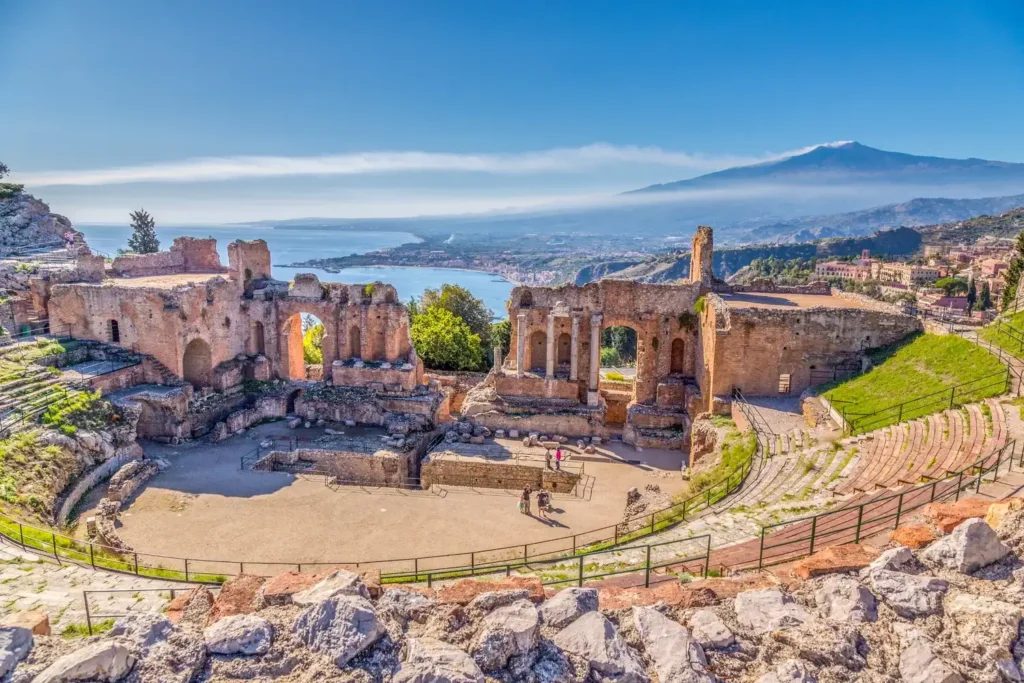
At the heart of the Mediterranean, Sicily reveals a unique identity, shaped by over three thousand years of history. Having been successively Greek, Roman, Byzantine, Arabic, Norman, and Spanish, the island now offers a cultural and architectural heritage that ranks among the richest in Europe.
Dominated by the imposing silhouette of Mount Etna, the highest active volcano on the continent, Sicily captivates as much by the diversity of its landscapes as by the authenticity of its traditions.
From perched medieval villages to elegant Baroque towns listed as UNESCO World Heritage sites, and from Greek temples overlooking the sea to the colorful markets of Palermo, every stop reveals a new facet of this land of character.
This grand tour was designed as a true immersion into the Sicilian soul.
Along panoramic roads, you will discover vineyards nestled on the fertile slopes of Mount Etna, taste a generous gastronomy with multiple influences, explore some of the most remarkable archaeological sites in the Mediterranean basin, and enjoy exceptional views over a sea of infinite shades.
Combining gastronomic experiences, authentic encounters, history-steeped villages, spectacular landscapes, and Mediterranean sweetness of life, this journey invites you to discover an elegant, sincere, and deeply endearing Sicily.
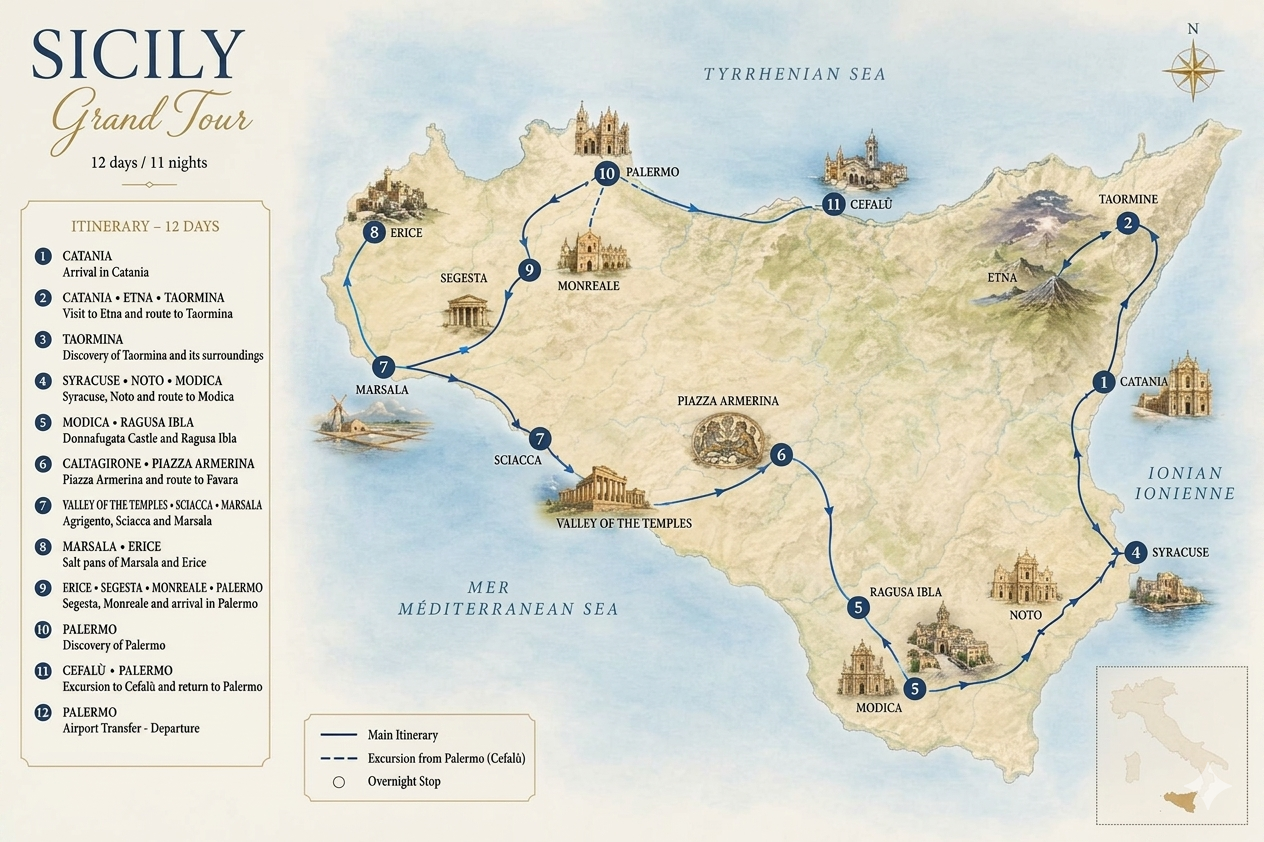
| 1 – 1 night Taormina | Arrival in Catania • Taormina | 60 km | 1 h |
| 2 | Etna • Winery • Castello degli Schiavi • Taormina | 90 km | 1 h 45 |
| 3 | Catania • Fish market • Cruise to Isola Bella • Taormina | 110 km | 2 h |
| 4 – 2 nights Modica | Syracuse • Ortigia • Noto • Modica | 205 km | 3 h 15 |
| 5 | Castle of Donnafugata • Ragusa Ibla • Modica | 65 km | 1 h 30 |
| 6 – 1 night Favara | Caltagirone • Piazza Armerina • Favara | 235 km | 3 h 30 |
| 7 – 2 nights Marsala | Valley of the Temples • Sciacca • Marsala | 185 km | 3 h |
| 8 | Marsala • Salt pans • Trapani | 85 km | 1 h 30 |
| 9 | Erice • Palermo | 145 km | 2 h 15 |
| 10 – 3 nights Palermo | Discovering Palermo | — | — |
| 11 | Cefalù • Palermo | 140 km | 2 h 30 |
| 12 | Palermo • Departure | 35 km | 45 min |
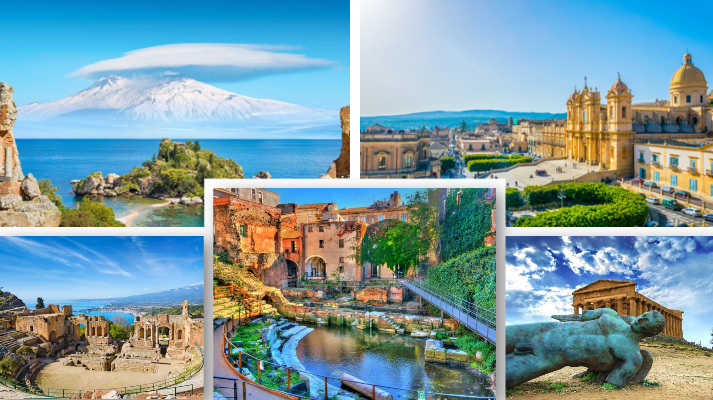
Day 1 – Welcome to Sicily
Catania • Taormina (Approx. 60 km – Travel time: approx. 1 hour) – 1night Taormina
Today… Your journey begins on the eastern coast of Sicily, where the Mediterranean meets the impressive slopes of Mount Etna. Upon arrival at Catania airport, pick up your rental vehicle before driving to Taormina, considered one of the most elegant seaside resorts in Italy.
Perched on a natural promontory overlooking the Ionian Sea, Taormina has captivated artists, writers, and travelers from around the world for centuries. Its pleasant climate, exceptional panoramas, and refined atmosphere make it one of Sicily’s jewels.
Depending on your arrival time, use this first day to discover the charm of its historical center. Stroll along Corso Umberto, a lively thoroughfare lined with historic palaces, elegant boutiques, cafés, and flower-filled small squares where it is a pleasure to linger.
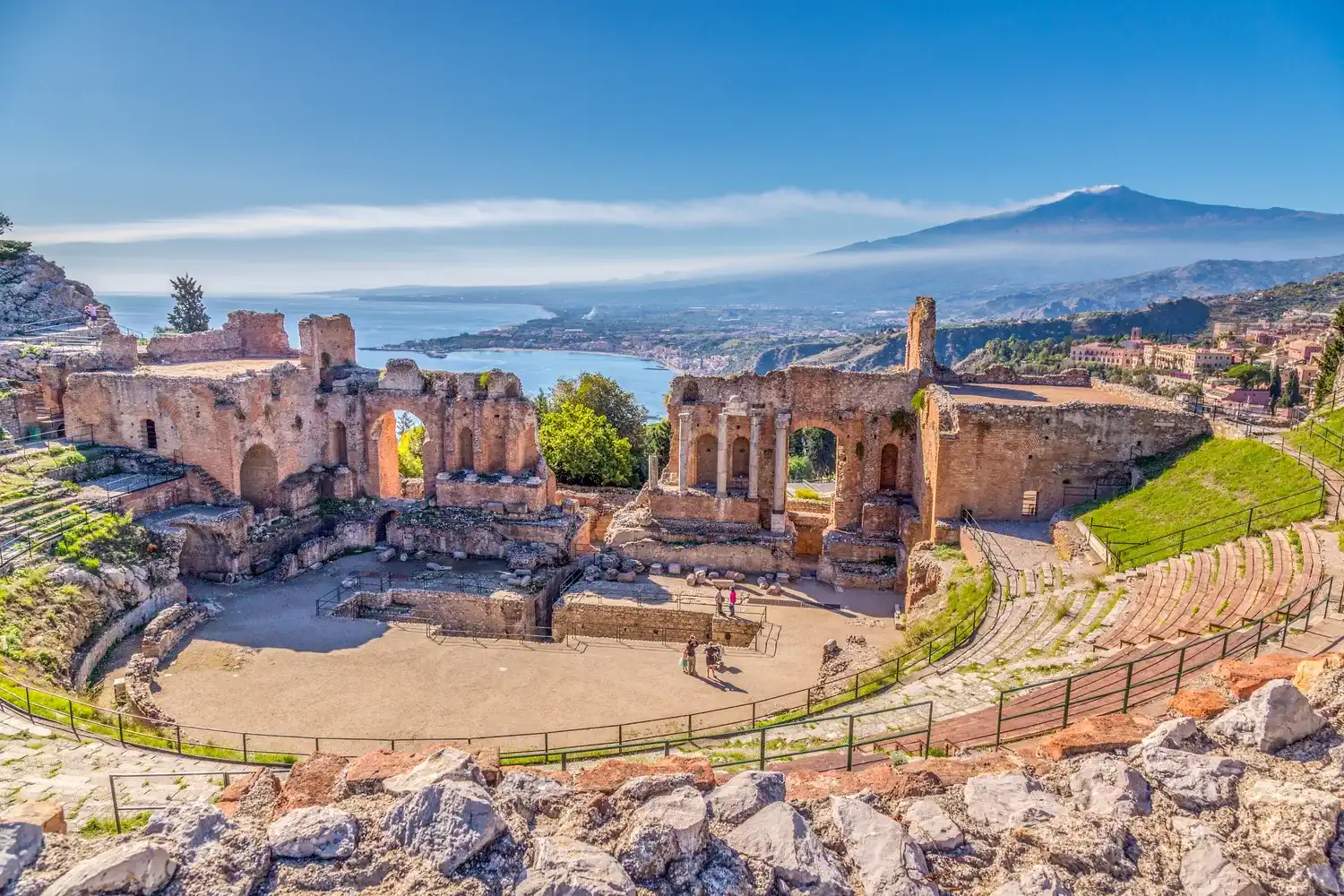
Do not miss the magnificent Ancient Theatre of Taormina, built by the Greeks and later expanded by the Romans. Dominating the bay, it offers one of the most beautiful panoramas in Sicily, with Mount Etna framing the horizon majestically on clear days.
Continue your walk to the gardens of the Villa Comunale, a true haven of peace offering superb viewpoints over the Ionian Sea. At the end of the day, sit at a café terrace to enjoy your first Sicilian aperitivo before relishing a dinner in one of the center’s many restaurants. It is the perfect opportunity to discover the island’s first flavors, featuring freshly caught fish, seafood pasta, arancini, and local sweets.
For this first evening, put aside itineraries and simply take time to stroll through the cobbled streets of Taormina.
- Insider Tip: When the last rays of sun illuminate the honey-colored facades and the terraces begin to come alive, the town reveals its full elegance. Find a spot on Piazza IX Aprile to admire the view of the Ionian Sea and Mount Etna, glass in hand. It is often in these suspended moments that the most beautiful travel memories are born.
Did you know?: The Ancient Theatre of Taormina, built in the 3rd century BC by the Greeks and later expanded by the Romans, is still used today to host international concerts and festivals. Few places in the world offer such a spectacular backdrop, with the Ionian Sea on one side and Mount Etna on the other.
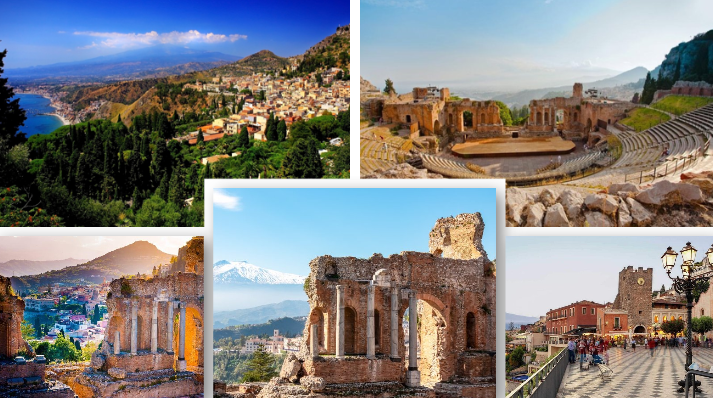
Day 2 – Between Fire, Vineyards, and Volcanic Panoramas
Taormina • Etna • Wine Estate • Castello degli Schiavi • Taormina (Approx. 90 km – Travel time: approx. 1h 45min)
Today… This day takes you on a discovery of one of Europe’s most impressive natural landscapes: Mount Etna, the highest active volcano on the continent. A true symbol of Sicily, it dominates the island in all its majesty and has shaped the landscapes, villages, and traditions of this region for millennia.
Leaving Taormina, the road climbs progressively through a succession of orchards, vineyards, and villages built from lava stone. As you ascend, the panoramas become more and more spectacular, offering remarkable views of the Ionian coast and volcanic reliefs.
Accompanied by your guide, you will discover Mount Etna’s lunar landscapes, molded by successive lava flows. Between ancient craters, solidified lava fields, and forests that have gradually reclaimed these volcanic lands, this excursion allows you to better understand the power of this volcano, which is still active, and the special relationship that Sicilians maintain with it.
In Sicily, life was built at the foot of the volcano. For centuries, inhabitants have learned to respect its strength while taking advantage of the extraordinary richness it offers to their land. It is this subtle balance between power and generosity that makes up the very soul of Mount Etna.
Mount Etna is much more than a volcano: it is a source of life. The volcanic soils, which are exceptionally rich, give birth to agricultural products renowned throughout Italy, notably wines of great finesse. You will continue your discovery with a visit to a wine estate located on the slopes of the volcano. This encounter will be an opportunity to understand the work of the winemakers who cultivate vines on these unique lands before enjoying a tasting accompanied by local specialties, in a setting offering magnificent panoramas over the vineyards and surrounding landscapes.
In the afternoon, stop at Castello degli Schiavi, an elegant 18th-century residence made famous for having served as a backdrop for several scenes in the movie The Godfather. This magnificent aristocratic residence, surrounded by gardens and citrus groves, reflects the rich past of the Sicilian nobility.
At the end of the day, return to Taormina where you will enjoy a free evening to continue your discovery of this timelessly charming town.
Did you know?: With its altitude of 3,300 meters (its summit varies slightly depending on eruptions), Mount Etna is the highest active volcano in Europe. Listed as a UNESCO World Heritage site, it is in almost permanent activity. Far from being only a threat, it also nourishes the most fertile lands of Sicily, allowing the cultivation of wines, citrus fruits, pistachios, and olives that rank among the most renowned in the country.
Insider Tip: If the weather is clear, take a few moments to admire the panorama from the heights of Mount Etna before descending to the coast. On a clear day, the view embraces a large part of eastern Sicily, between the Ionian Sea, villages clinging to the volcano’s flanks, and landscapes shaped by centuries of volcanic activity. A grandiose spectacle that reminds us of the sheer power of nature.
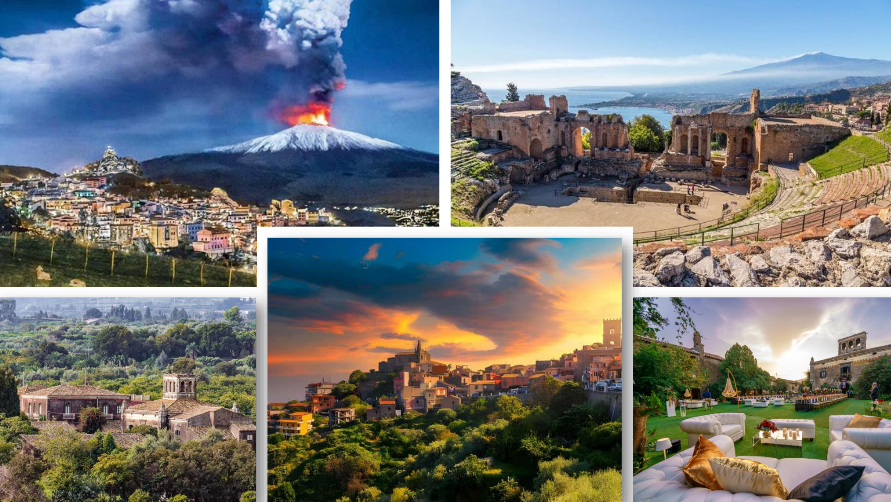
Day 3 – Between Maritime Traditions and Mythical Shores
Catania • Fish Market • Cruise to Isola Bella • Taormina (Approx. 110 km – Travel time: approx. 2 hours)
Today… This day invites you to discover another facet of Sicily, intimately linked to the sea. Since time immemorial, the Mediterranean has shaped the daily life of Sicilians, their gastronomy, their traditions, and their history.
You first head to Catania, a dynamic city built at the foot of Mount Etna. Rebuilt in lava stone after the terrible earthquake of 1693, it captivates with its Baroque architecture, its lively atmosphere, and its elegant squares listed as a UNESCO World Heritage site.
At the heart of the historical center, let yourself be surprised by the effervescence of the famous Pescheria, Catania’s fish market. A true local institution, this colorful market is an immersion into daily Sicilian life. The stalls overflow with freshly caught fish, seafood, and local specialties, while vendors perpetuate a commercial tradition that is centuries old.
In Catania, the market is much more than a place of commerce: it is a living spectacle where the fragrances of the sea, Sicilian accents, and a communicative energy mingle to form the very soul of the city.
In the late morning, return to the Taormina coast to step onboard a boat and discover one of Sicily’s most beautiful coastlines. The navigation skirts cliffs, secret coves, and marine caves before reaching the natural reserve of Isola Bella, a true jewel set in the crystal-clear waters of the Ionian Sea. Depending on weather conditions, a swimming break will allow you to fully enjoy this exceptional setting.
Seen from the sea, Taormina reveals an entirely different face: its hanging gardens, its steep cliffs, and the majestic silhouettes of Mount Etna that dominate the horizon compose an unforgettable panorama.
Return to Taormina in the late afternoon to enjoy your evening freely.
- Insider Tip: After your boat excursion, sit on a terrace facing the sea to savor a Sicilian granita accompanied by a brioche, an iconic specialty of the island. It is a local tradition that is particularly appreciated during sunny days and a delicious way to prolong the sweetness of this day between sea and volcano.
Did you know?: Connected to the shore by a thin sandbar that sometimes disappears beneath the waves depending on tides and sea conditions, Isola Bella is nicknamed “the Pearl of the Ionian Sea”. Classed as a natural reserve, it houses a remarkable terrestrial and marine biodiversity.very first time
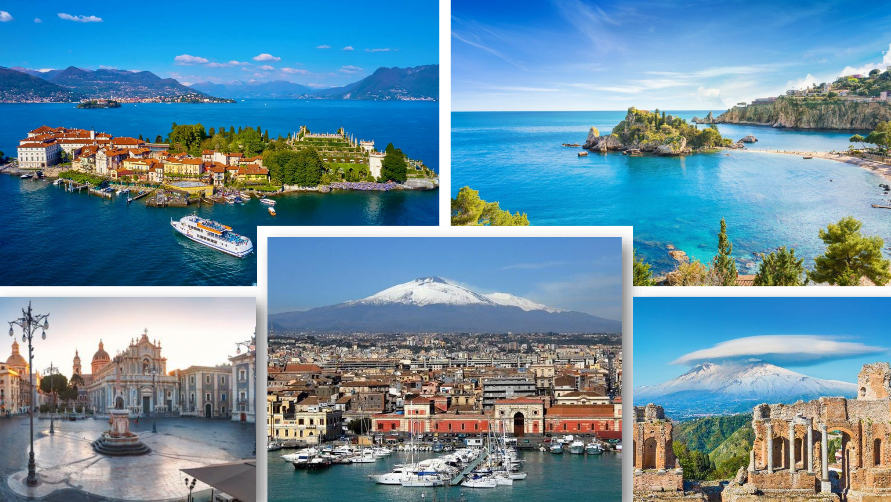
Day 4 – From the Greeks to Sicilian Baroque
Taormina • Syracuse • Ortigia• Noto • Modica (Approx. 170 km – Travel time: approx. 3 hours) – 2 nights Modica
Today… Leaving the eastern coast, your journey leads you toward the southeast of Sicily, a region where every town tells a chapter of the island’s history. From the vestiges of Magna Graecia to sumptuous Baroque cities, this day is a true immersion into several centuries of civilization.
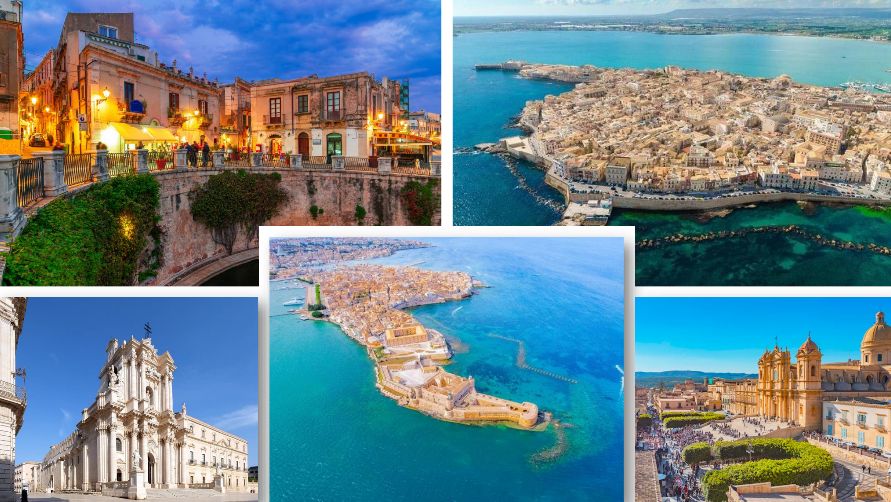
In the late morning, you meet your guide in Syracuse, one of the most powerful cities of the ancient Greek world. Founded in the 8th century BC, it once rivaled Athens in wealth, cultural influence, and reach across the entire Mediterranean.
Your discovery continues on the island of Ortigia, the true historical heart of Syracuse. Behind its light-bathed alleys unfold elegant squares, palaces with facades weathered by time, and an atmosphere where antiquity dialogues naturally with the sweetness of Sicilian life. You will notably admire the magnificent Syracuse Cathedral, built over the foundations of an ancient Greek temple dedicated to Athena, as well as the famous Aretusa Fountain, whose legend is intimately linked to Greek mythology.
After free time for lunch, the route continues to Noto, often considered the capital of Sicilian Baroque. Entirement rebuilt after the earthquake of 1693, the city reveals a remarkable ensemble of palaces, churches, and residences with honey-colored facades that turn a golden hue under the afternoon light.
Nicknamed the “Stone Garden”, Noto invites you to an enjoyable stroll along its elegant main street, punctuated by majestic monuments and charming squares where it feels good to pause for a few moments. It is impossible to leave the city without tasting one of its most appreciated specialties: the delicious almond granita, a true local institution.
At the end of the day, you reach Modica, a superb city built on a hillside. Its light stone houses, steep alleys, and numerous churches give it a unique charm. Settle into your hotel before enjoying dinner in the historical center or at the hotel restaurant, according to your program.
- Insider Tip: Take the time to admire Noto in the late afternoon, when the light becomes softer. The limestone facades then take on golden nuances that have made the city famous. Sit for a few moments on a café terrace to savor an almond granita and observe Sicilian life flowing peacefully around you.
Did you know?: Syracuse Cathedral is a fascinating example of Sicily’s turbulent history. By looking closely at its walls, you can still distinguish the imposing columns of the Greek temple dedicated to Athena, integrated into the Christian edifice. Few monuments illustrate so clearly the superposition of the great civilizations that shaped the island.
Day 5 – Between Perched Villages and Southern Sicilian Flavors
Modica • Ragusa Ibla • Donnafugata Castle • Modica (Approx. 75 km – Travel time: approx. 1h 30min)
Today… After discovering the splendors of Sicilian Baroque, this day invites you to explore a region where heritage, traditions, and the art of living blend harmoniously.
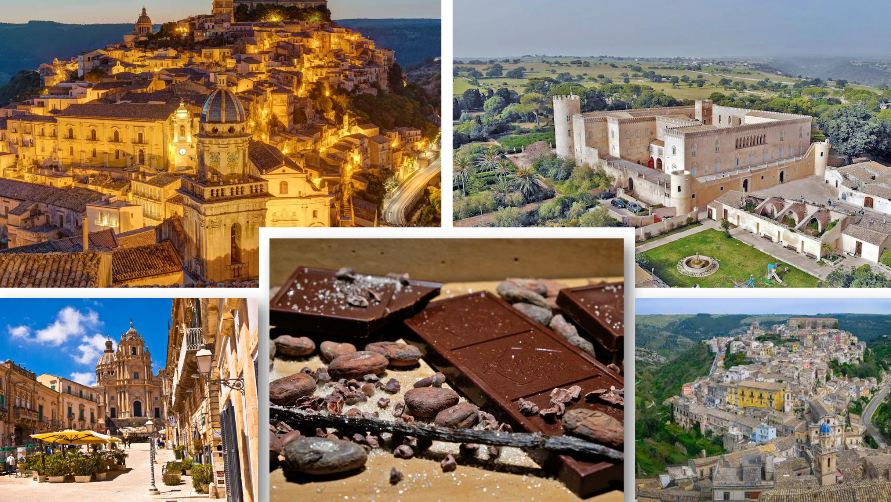
Your morning begins in Modica, a city inscribed on the UNESCO World Heritage list and renowned for its exceptional Baroque architecture. Built on a hillside, it reveals a tangle of steep alleys, picturesque staircases, and monumental churches that seem to rise one above the other.
But Modica is also famous for a unique craftsmanship in Europe: its chocolate, crafted according to a method inherited from the Aztecs and introduced to Sicily during the Spanish era. Its slightly grainy texture and authentic flavors make it a true local specialty. In Modica, history is savored as much as it is contemplated. Behind every Baroque facade hide traditions that have been transmitted for centuries.
Your discovery continues toward Ragusa Ibla, probably one of the most elegant towns in Sicily. Entirely rebuilt after the earthquake of 1693, it offers a remarkable ensemble of palaces, churches, and hanging gardens that give it a timeless charm. Along your walk, you will discover its cobbled streets, its ornate balconies, its peaceful squares, and the honey-colored facades that capture the Sicilian light beautifully. Here, time seems to slow down, inviting you simply to enjoy the unique atmosphere of the place.
The afternoon leads you to Donnafugata Castle, a magnificent aristocratic residence surrounded by gardens and a vast estate. More than a fortified castle, it is an elegant 19th-century residence, famous for its eclectic architecture, its richly decorated salons, and its fascinating stone labyrinth that delights visitors.
At the end of the day, return to Modica where you can enjoy a free evening in the warm atmosphere of this Baroque city.
- Insider Tip: Before leaving Modica, push open the door of an artisanal chocolate shop to discover the city’s famous chocolate. Tasted plain or flavored with citrus, cinnamon, or chili, it constitutes one of the most beautiful gastronomic heritages of Sicily and a delicious way to extend your discovery of the region.
Did you know?: Modica chocolate is crafted using an ancestral “cold” technique, which prevents the sugar from melting completely. It is this traditional method that gives it its slightly grainy texture, so different from the chocolate we usually know. This craftsmanship is now recognized as one of the gastronomic emblems of Sicily.
Day 6 – In the Heart of Authentic Sicily
Modica • Caltagirone • Piazza Armerina(Approx. 180 km – Travel time: approx. 3h 15min) – 1 night Favara
Today… Leaving the elegant Baroque cities of the southeast, your journey takes a new direction. The route progressively sinks into the Sicilian hinterland, revealing a more discreet, more rural island, where hills roll as far as the eye can see between olive groves, vineyards, and wheat fields.
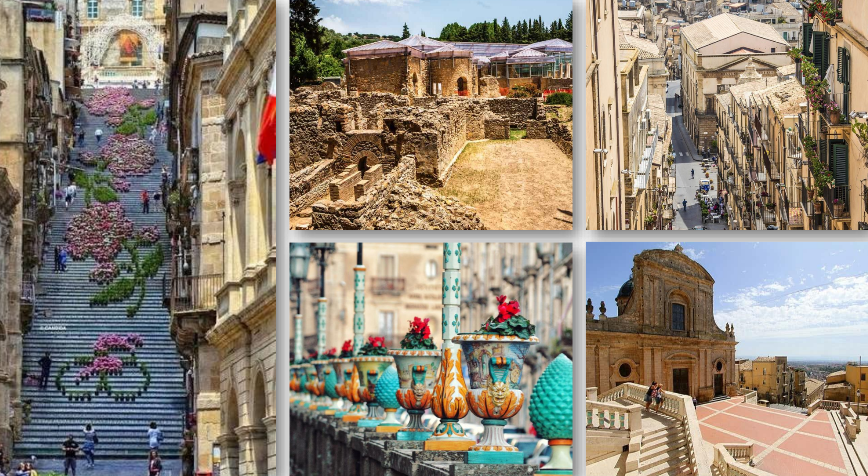
First stop of the day: Caltagirone, the undisputed capital of Sicilian ceramics. For over a millennium, artisans have passionately crafted pieces with vibrant colors that have become one of the symbols of the island.
Along your walk through the historical center, you will discover numerous artisan shops as well as the famous Scalier de Santa Maria del Monte, composed of 142 steps decorated with ceramic tiles, each one different. A true open-air work of art, it illustrates all the skill and creativity of Sicilian master ceramicists. In Caltagirone, ceramics are not just a simple craft. They are part of the landscape, the houses, the squares, and the memory of the inhabitants.
After this artistic interlude, the road crosses the peaceful landscapes of the heart of Sicily to Piazza Armerina, a charming town dominated by its medieval heritage.
There, you will discover one of the most extraordinary archaeological treasures in Italy: the Villa Romana del Casale, listed as a UNESCO World Heritage site. This sumptuous Roman villa, dating from the 4th century, is famous for preserving one of the most extensive collections of ancient mosaics in the world. Room after room, hunting scenes, mythological representations, exotic animals, and the famous “bikini girls” bear witness to the refinement of aristocratic life in the Roman era and the incredible artistic mastery of their creators.
Settling into your hotel at the end of the day.
- Insider Tip: Take the time to observe the details of the mosaics rather than trying to see everything quickly. Each room tells a different story: a hidden animal, a mythological character, or a scene from daily life. The more you contemplate them, the more they reveal their incredible richness.
Did you know?: The Villa Romana del Casale preserves nearly 3,500 m² of mosaics, an ensemble considered the best-preserved in the entire Roman Empire. The famous mosaics representing young women practicing sports activities are often nicknamed the “ancient bikinis”, although they are actually training outfits over 1,600 years old.
Day 7 – In the Footsteps of Magna Graecia
Piazza Armerina• Agrigente• Valley of the Temples • Sciacca (Approx. 170 km – Travel time: approx. 3 hours) – 1 night Marsala
Today… Your journey continues toward the southern coast of Sicily, where ancient history unfolds in all its splendor. The landscapes change once again: the interior hills progressively give way to vast expanses bathed in light that border the Mediterranean.
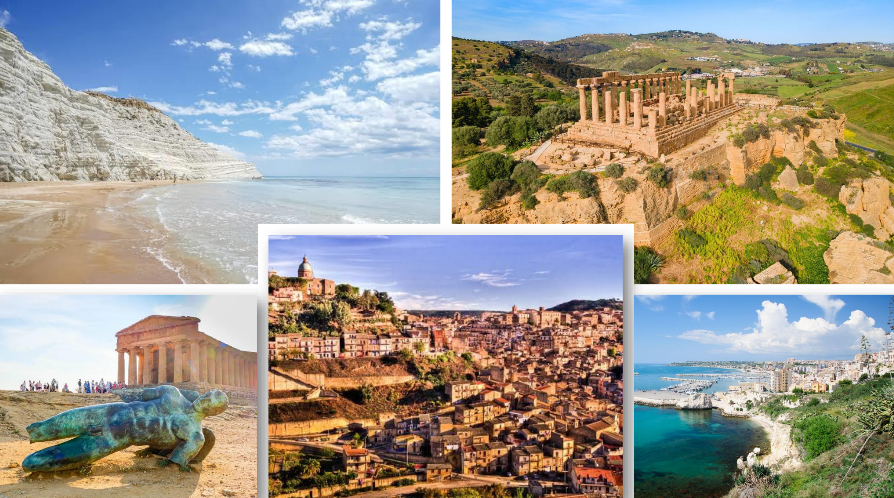
You reach Agrigento, an ancient Greek city founded in the 6th century BC, once considered one of the most prosperous cities of the ancient world. This is where one of the most remarkable archaeological sites in the entire Mediterranean is located: the famous Valley of the Temples, listed as a UNESCO World Heritage site.
Along your walk, you will discover an exceptional ensemble of beautifully preserved Doric temples, including the majestic Temple of Concord, considered one of the best-preserved Greek temples in the world. Between cypresses, century-old olive trees, and almond trees, the site offers a unique atmosphere where the silence still seems to carry the echo of the great civilizations that shaped Sicily.
In Agrigento, the stones tell over two thousand years of history. Each column recalls the extraordinary influence of Magna Graecia on the shores of the Mediterranean.
After this immersion into antiquity, the road skirts the southern coastline to Sciacca, a charming port town renowned for its maritime traditions, its thermal baths, and its craftsmanship. Overlooking the sea, Sciacca captivates with its colorful alleys, its lively squares, and its fishing port where boats still return every day with their catch.
Settling into your hotel in the late afternoon.
- Insider Tip: If your arrival in Sciacca coincides with the end of the day, treat yourself to a walk to the port. Watching the fishermen return, observing the colors of the setting sun on the pastel facades, and smelling the sea air offers a magnificent contrast after the monumental vestiges of Agrigento.
- Did you know?: The Temple of Concord, built around 430 BC, is one of the best-preserved Greek temples in the world. Its remarkable preservation is notably explained by its transformation into a Christian church in the 6th century, which allowed it to escape the destruction that affected many other ancient edifices.
Day 8 – Between Salt Pans, Great Wines, and Coastal Village
Sciacca • Marsala • Salt Pans • Erice (Approx. 190 km – Travel time: approx. 3h 15min)
Today… Your itinerary leads you toward the western extremity of Sicily, a region where the sea, the wind, and the sun have shaped the landscapes for centuries.
The road runs along the coast to Marsala, a town world-famous for the wine that bears its name. Its elegant historical center, its Baroque palaces, and its light-bathed alleys reflect a rich commercial past open to the entire Mediterranean.
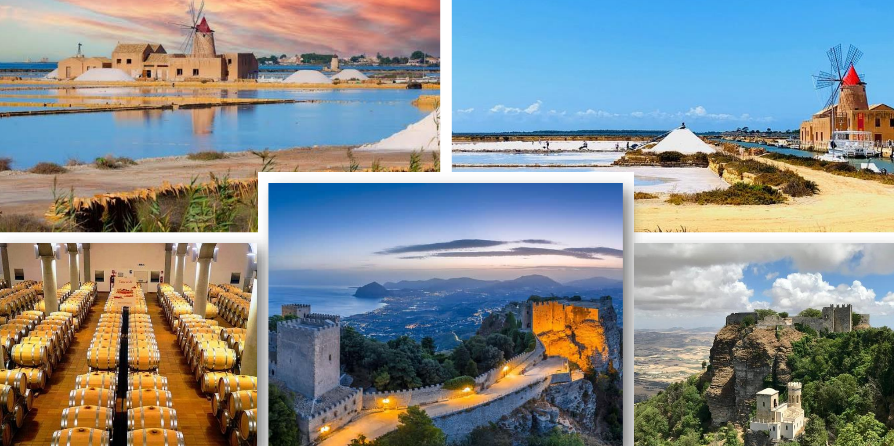
You will discover the famous salt pans of Marsala, where basins with changing reflections compose a landscape of great beauty. Since antiquity, salt has been harvested there using the sun and wind, according to traditional methods that endure to this day.
The iconic windmills that punctuate the salt pans recall the importance of this activity, which was once essential to the region’s economy. Here, the wind, the sun, and the sea have worked together for centuries to shape one of the most iconic landscapes of Sicily.
Your discovery continues with a tasting at a wine estate, where you will learn more about the creation of the famous Marsala wine, whose reputation extends far beyond Italian borders.
Continuing your route, you reach Erice, a magnificent medieval village perched more than 700 meters above sea level. Its cobbled streets, its ramparts, its flower-filled small squares, and its spectacular panoramas over the western coast offer one of the most beautiful ends of the day of the journey.
Settling into your hotel.
- Insider Tip: As you wander the alleys of Erice, let yourself be guided without a precise itinerary. Behind every cobbled street hide small flower-filled courtyards, artisan workshops, and unexpected panoramas over the Egadi Sea. It is a village to be discovered slowly, at the rhythm of your walk.
Did you know?: The Marsala salt pans have been producing salt for over two thousand years. Even today, certain operations use the same traditional techniques as in the past, making this landscape a precious testimony to Sicilian heritage as well as an exceptional natural site.
Day 9 – From the Heights of Erice to the Treasures of Palermo
Erice • Ségeste • Monreale • Palermo (Approx. 140 km – Travel time: approx. 2h 45min)
Today… Upon waking, enjoy the peaceful atmosphere of Erice for a few more moments before taking the road toward a new page of Sicilian history.
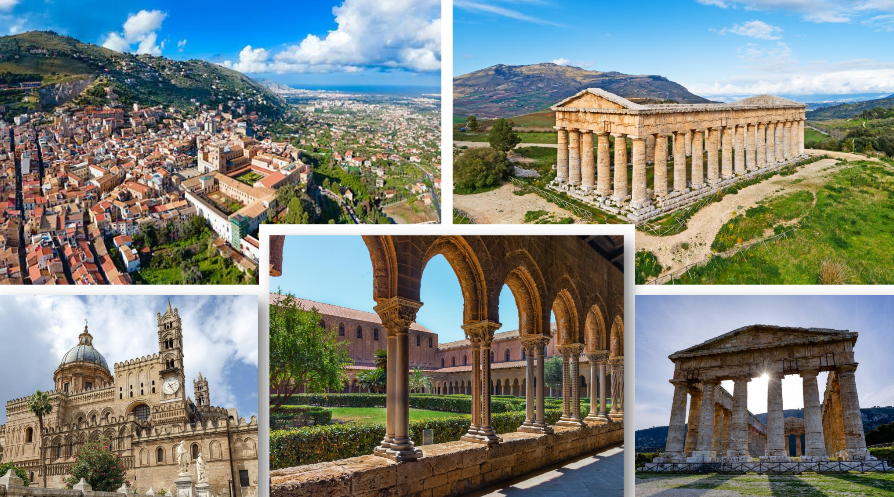
Your first discovery is dedicated to the remarkable archaeological site of Segesta, an ancient city founded by the Elymians. Isolated in the heart of a hilly landscape, its majestic Doric temple seems to defy time for over two thousand years. Further on, the ancient theater, backed against the mountain, offers an exceptional panorama over the Sicilian countryside.
The road then leads you to Monreale, where one of the greatest wonders of Norman art stands. Its cathedral impresses as much by its dimensions as by the brilliance of its Byzantine mosaics covering nearly 6,500 m² of walls and vaults.
The thousands of golden tesserae catch the light and create an almost surreal atmosphere. At Monreale, each mosaic tells an episode of biblical history. Together, they compose one of the most extraordinary artistic ensembles of the Middle Ages.
In the late afternoon, arrive in Palermo, the vibrant capital of Sicily, where Arabic, Norman, Spanish, and Italian influences have mingled for centuries.
Settling into your hotel.
- Insider Tip: If time permits, spend a few minutes in the cloister of Monreale before leaving. Its calm contrasts wonderfully with the richness of the cathedral and simply invites contemplation.
- Did you know?: The famous Christ Pantocrator of Monreale is composed of several million tiny glass and gold tesserae. It has become one of the most iconic symbols of all Sicily.
Day 10 – Palermo, Crossroads of Civilizations
Discovering Palermo (Travel time: low – Distance: depending on visits) – 3 nights Palermo
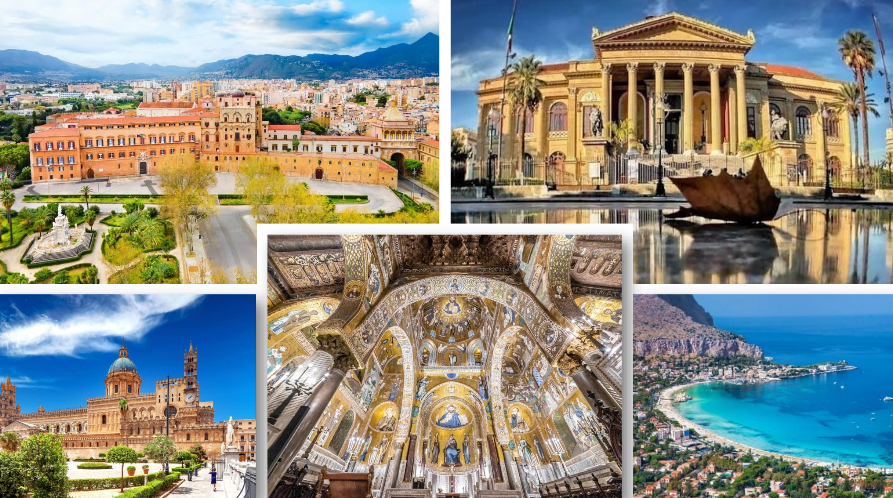
Today… It is impossible to understand Sicily without discovering Palermo. Founded by the Phoenicians, developed by the Arabs, embellished by the Normans, and then marked by the Spanish, the Sicilian capital is a true open-air history book.
Throughout your guided tour, you will discover its iconic monuments, its palaces, its lively squares, and its markets where the popular traditions of the island still echo. The Cathedral, the Norman Palace, the Palatine Chapel, historical squares, and shopping streets each tell a different era.
But Palermo is also discovered through its atmosphere:
- The lively terraces.
- The facades, sometimes majestic, sometimes weathered by time.
- The food fragrances escaping from the trattorias.
- The scooters crisscrossing the alleys.
Everything here bears witness to a deeply alive city. Palermo is not just visited. It is felt.
- Insider Tip: Treat yourself to a moment on a terrace of the Piazza Pretoria or in a lively street of the historical center. Simply observing the daily life of the Palermitans is an integral part of discovering the city.
- Did you know?: Palermo has successively experienced the Phoenicians, Carthaginians, Romans, Arabs, Normans, Swabians, Angevins, Aragonese, and then the Bourbons. Few Mediterranean cities present such a rich cultural heritage.
Day 11 – The Sweetness of Life Facing the Mediterranean
Palermo • Cefalù • Palermo (Approx. 140 km round trip – Travel time: approx. 2 hours)
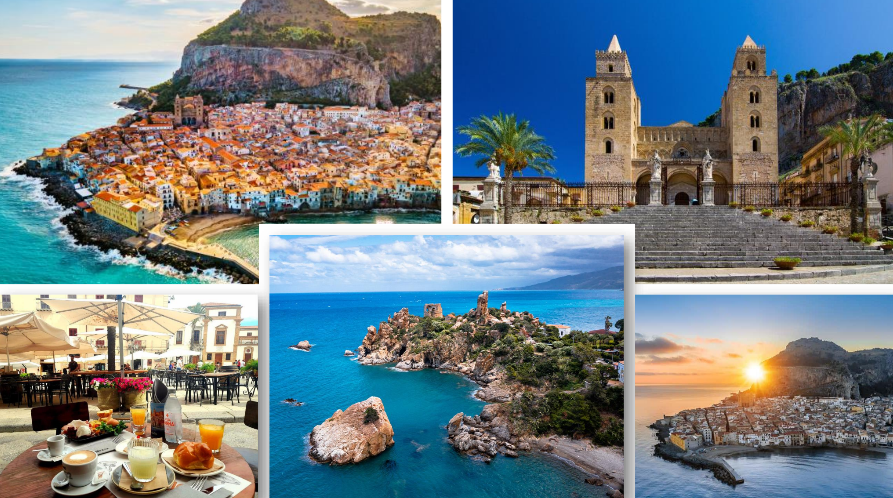
Today… This day leads you toward Cefalù, one of the most beautiful villages on the Sicilian coastline. Dominated by its impressive rocky promontory, this ancient fishing town immediately captivates with its discreet elegance.
Along the cobbled streets, you will reach the magnificent Norman cathedral, listed as a UNESCO World Heritage site, before continuing your walk to the old port where colorful boats gently rock to the rhythm of the sea.
Here, everything invites you to slow down:
- The houses with ocher facades.
- The small shaded squares.
- The cafés open to the Mediterranean.
- The light reflecting on the crystal-clear waters.
In Cefalù, time seems to flow a little more slowly, as if the Mediterranean naturally imposed its own rhythm. Return to Palermo in the afternoon.
- Insider Tip: Before leaving Cefalù, walk to the ancient medieval washhouse. Fed by a natural spring, it constitutes one of the most authentic and photographed places in the town.
Did you know?: According to an ancient legend, the rock dominating Cefalù was born from the tears of a giant who came to weep for the loss of his beloved.
Day 12 – Arrivederci Sicilia….
Palermo • Airport (Approx. 35 km – Travel time: approx. 45 min)
Today… Depending on your flight schedule, enjoy your last moments in Sicily.
Perhaps time for an espresso on a sunny terrace, a final walk through the alleys of Palermo, or simply a few glances toward this island which, over the days, will have revealed a thousand faces to you.
From the slopes of Mount Etna to Roman mosaics, from Greek temples to Baroque villages, from the Marsala salt pans to the lively streets of Palermo… Sicily can never be summarized in a single image.
It is a mosaic of cultures, landscapes, traditions, and encounters that leaves a different memory for everyone. Transfer to the airport and assistance with formalities before your return flight.
- Insider Tip: Before leaving the island, slip a few Sicilian flavors into your luggage — olive oil, Bronte pistachios, some almond sweets, or a piece of Modica chocolate. They will extend your journey a little once you are back home.
- Did you know?: Sicily is the largest island in the Mediterranean. For over three thousand years, it has welcomed and inspired travelers, merchants, artists, and civilizations from all horizons of this sea that unites peoples as much as it separates them.